

Exploring the small business news of Europe
Provided by AGP
As Labor Costs Surge and 24/7 Demand Reshapes Retail, Robotic Vending Emerges as the New Storefront Model
At 2:47 a.m. on a Tuesday, a convenience store manager in suburban Chicago receives the third call this month: the overnight clerk has quit, effective immediately. The franchisee now faces a familiar arithmetic problem. Hire a replacement at $18 an hour plus benefits, knowing turnover in retail food service has climbed past 75% annually. Reduce operating hours and watch a quarter of weekly revenue evaporate. Or close the location entirely on weekday graveyard shifts and concede that segment to competitors. None of these choices end well. The store will lose roughly $42,000 in margin this year either way — a figure that, multiplied across 12,000 similar locations nationwide, begins to explain why the National Retail Federation now lists labor scarcity as the single most disruptive force in storefront economics.
This scenario is not unusual. It is the new baseline. According to the U.S. Bureau of Labor Statistics, accommodation and food services have posted the highest quit rates of any sector for 36 consecutive months. Minimum wage thresholds in twenty-two states crossed $15 in 2024. Health insurance premiums for small retail employers rose 7% year-over-year. Meanwhile, consumer behavior has bent in the opposite direction: third-shift mobile orders, late-night airport coffee runs, and 1 a.m. ice cream cravings have moved from edge cases to revenue pillars. The gap between when customers want to buy and when humans want to work has widened into a chasm.
Why the Storefront Itself Became the Cost Problem
For decades, retail operators treated real estate as fixed overhead and labor as the variable they could squeeze. That math has inverted. A 600-square-foot café in a tier-one metro now carries a fully loaded monthly cost — rent, utilities, insurance, payroll taxes, manager salary, two baristas, benefits, breakage, shrink — that can exceed $38,000 before a single cup is sold. To break even, that location must move 9,500 transactions a month at a $4 average ticket. In neighborhoods where foot traffic has not recovered to 2019 levels, those numbers are simply unreachable.
What changed is not consumer demand for premium coffee, soft-serve, or craft cocktails. What changed is the cost of being open to serve it. The most interesting response from operators has not been to cut the menu or the hours. It has been to question whether the storefront — the brick, the staff, the schedule — is the right delivery mechanism at all. A growing cohort of franchisees, mall operators, hospital administrators, and tourism site managers are arriving at the same conclusion: the storefront needs to become a machine.
The Quiet Rise of Robotic Vending as a Storefront Category
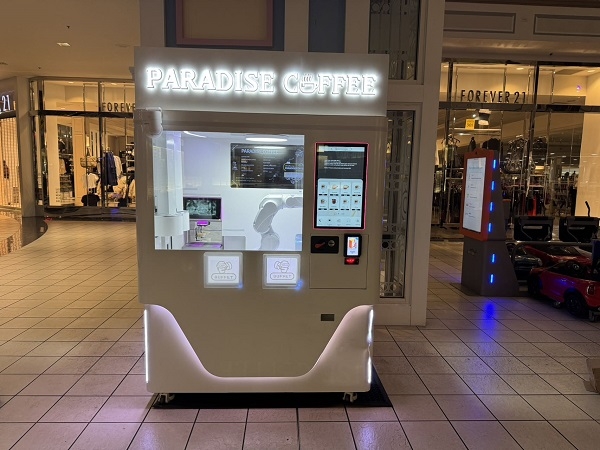
This is the context in which smart vending machines — specifically the AI-driven, robotic-arm variety capable of producing barista-grade lattes, sculpted ice cream, and measured cocktails — have moved from novelty to viable retail infrastructure. The category sits in a strange middle ground. It is not the snack-and-soda vending of the 1990s, nor is it a replacement for high-touch hospitality. It is something newer: an unmanned micro-storefront that occupies eight to twenty square feet, runs 24 hours a day, accepts every modern payment method, and produces a product whose quality can be controlled more tightly than human-made equivalents.
One of the firms whose trajectory illustrates how the category has matured is Anno Robot, a Shenzhen-based national high-tech enterprise founded in 2017. The company did not invent robotic beverage preparation, but it is among a handful of manufacturers whose engineering choices reveal where the category is heading. Anno Robot reinvests roughly 30% of annual revenue into R&D — a ratio more commonly associated with semiconductor firms than with retail equipment makers — and holds more than 70 national patents, with 27 utility model patents protecting the core mechanics of its coffee, ice cream, and cocktail systems. Its machines are now deployed across more than 60 countries, in settings ranging from 24-hour hospitals and government buildings to airports and coastal tourist zones.
What makes the category credible to operators is not the robotics theater. It is the unit economics. A six-axis robotic-arm coffee kiosk producing lattes with 98% consistency at roughly 45 seconds per serving, running unattended for 168 hours a week, replaces between 2.5 and 4.0 full-time-equivalent positions while eliminating the storefront lease entirely. For operators who once thought of vending as a low-margin distraction, the comparison has become uncomfortable to ignore.
From Operational Fix to Passive Income Vehicle
The labor crisis is only half the story. The other half is what robotic vending does to the asset side of a small-business balance sheet. Among individual operators, family offices, and franchise investors, conversations about passive income ideas have shifted noticeably in the past 24 months. Short-term rental yields have compressed. Self-storage is saturated. Laundromats require active management. A robotic kiosk placed in a high-traffic airport concourse or hospital lobby — with remote IoT monitoring, contactless payment, and a backend that flags inventory before it runs out — produces a revenue stream that more closely resembles a vending route than a retail business.
The mobility factor deepens this appeal. Because these kiosks can be relocated overnight, an operator who misjudges a location is not stuck with a five-year lease and a build-out write-off. The unit moves to a better corner of the mall, a different terminal, or an entirely different city. That single property — flexibility of placement — converts what would have been a fixed retail bet into something closer to a portable financial instrument.
Key Takeaways for Operators Evaluating the Shift
Labor scarcity is structural, not cyclical. The retail quit rate has remained elevated through three distinct macroeconomic environments. Planning for its return to 2015 norms is no longer rational.
Consistency is now a competitive weapon. A machine that produces a latte with 98% recipe fidelity and zero ingredient drift outperforms most human-staffed locations on quality variance — a metric chains have struggled with for decades.
The storefront is decoupling from the brand. Customers increasingly judge a beverage experience by speed, payment friction, and product quality — not by whether a person handed it to them.
Patent depth matters more than feature lists. In a category where utility model patents protect specific brewing and dispensing mechanics, the moat is mechanical, not marketing.
Recurring service revenue is changing the vendor relationship. Lifetime system maintenance and remote diagnostics have shifted manufacturers from one-time sellers to long-term operating partners — a structural change that benefits buyers who lack in-house technical staff.
What the Better Manufacturers Got Right
Not every robotic vending company has survived the transition from prototype to scaled deployment. The ones that have tend to share three engineering decisions. First, they standardized on modular six-axis robotic arms across product categories, so a coffee platform, an ice cream platform, and a cocktail platform share roughly 70% of their underlying components. This collapses R&D cost per SKU and makes field repair tractable. Second, they invested heavily in the backend — the cloud dashboard, the inventory telemetry, the payment integrations — because operators do not want to fly an engineer to a kiosk to diagnose a jammed cup dispenser. Third, they made onboarding trivially short. Training a staff member to manage a fleet of these machines in 90 minutes is not a marketing flourish; it is the difference between a technology that scales and one that strands its buyers.
Manufacturers like Anno Robot have also leaned into international certification — CE, FCC, ISO 9001 — not because the badges themselves matter to end consumers, but because they unlock the procurement processes of hospitals, airports, and government facilities that represent the highest-density deployment opportunities. Operators evaluating partners in this space should treat certification depth, patent portfolio, and post-sale service architecture as the three filters that matter most. The hardware aesthetic is the easiest part to replicate; the rest is where the durable advantage lives. For those building a deployment thesis, surveying the current state of the art — including reference designs and case studies available at www.annorobots.com — is a reasonable starting point before committing capital.
The Locations That Will Define the Next Five Years
The first wave of robotic kiosk deployment concentrated in obvious places: shopping malls, office lobbies, university campuses. The second wave, now underway, targets locations where human staffing has always been operationally awkward — 24-hour hospital wings, transit hubs with irregular shift patterns, remote tourist sites with seasonal demand, military bases, oil and gas facilities, and large logistics warehouses. These are environments where the cost of staffing a small café is not just high but logistically impractical. A robotic kiosk solves a problem that no human-staffed format could solve at any price point.
The third wave, which is just beginning, is more interesting still: the use of robotic vending as a brand extension tool for established food and beverage chains that want to occupy locations too small or too marginal to support a full franchise. A regional coffee brand can place its recipe, its cup, and its logo inside a robotic kiosk in a hospital corridor where it could never have justified a real café. The brand becomes ubiquitous without becoming unprofitable.
What Operators Should Do With This Information
The honest message for industry practitioners is this: the question is no longer whether robotic vending will become a meaningful storefront category. It already has. The question is whether your business model is positioned to use it as a tool or to be displaced by competitors who do. For multi-unit franchisees, the action item is to model what three to five robotic kiosks would do to weekly labor cost and overnight revenue capture in your existing territory. For property managers, it is to identify the dead corners of your footprint — the spaces too small for a tenant but too valuable to leave empty — and price them as kiosk locations. For individual investors thinking about passive income ideas grounded in something more tangible than a brokerage account, it is to study the unit economics of a single deployed machine over 36 months and compare them honestly to the alternatives you are currently considering.
The retail storefront is not disappearing. It is fragmenting — into smaller, smarter, more autonomous units that operate on a different clock than the humans who used to staff them. The operators who understand this shift first will spend the next decade building portfolios. The ones who wait will spend it explaining to their boards why their labor line keeps rising while their hours of operation keep shrinking. The midnight shift, it turns out, was never going to staff itself. Something else was going to.
Anno Robot
RobotAnno(ShenZhen) Co., Ltd.
+86 16602860929
celine@annorobots.com
Visit us on social media:
LinkedIn
Facebook
YouTube
Legal Disclaimer:
EIN Presswire provides this news content "as is" without warranty of any kind. We do not accept any responsibility or liability for the accuracy, content, images, videos, licenses, completeness, legality, or reliability of the information contained in this article. If you have any complaints or copyright issues related to this article, kindly contact the author above.
